
Not All Repos Are the Same: Bank Repos vs. Insurance-Loss Cars
Many car buyers shop for repos to find deals. But most shoppers do not know something important. Not all repos are the same.
Some repos are clean-title vehicles taken by a bank because of missed payments.
Others are insurance-loss vehicles with hidden accident or flood history.
They may also be repossessed, but they are nothing like true bank repos.
This guide explains the difference in simple terms. It also explains why RepoFinder only links to true bank repos, not mixed salvage inventory.
Why People Shop for Repos in the First Place
Most shoppers want:
-
Lower prices
-
Honest listings
-
Clean titles
-
Normal wear
-
Easy buying steps
Bank repos often check all these boxes. But salvage auctions may not. They blend many types of cars together. This creates confusion for buyers.
Understanding True Bank Repos
A true bank repo is simple to understand.
The borrower stops paying.
The bank takes the vehicle back.
The vehicle is then sold.
Key traits of true bank repos
-
Clean titles in most cases
-
Normal wear from daily use
-
No insurance payout history
-
No flood branding
-
No structural rebuild
-
Owned by a bank or credit union
-
Often well maintained
-
Usually cheaper than dealer lots
Banks want the loss off their books quickly. That creates buyer value.
What Insurance-Loss “Repos” Actually Are
Insurance-loss cars are different.
They enter auctions after major events like:
-
Accidents
-
Floods
-
Total loss claims
-
Engine failures
-
Fire damage
-
Theft recovery
Sometimes the owner stops paying after the damage.
The lender repossesses what is left.
It still enters the system as a “repo,” but in truth it is a damaged insurance-loss unit.
Key traits of insurance-loss repos
-
May show a clean title now
-
Often become branded after registration
-
Often repaired by unknown shops
-
May include flood cars
-
May include structural damage
-
Often have hidden mechanical issues
-
Often sold “as-is” with no return
-
Often mixed with salvage auction inventory
These cars are nothing like pure bank repos.
Why Some Damaged Cars Still Show “Clean Title”
Many shoppers get confused here.
The title stays clean in some states until the car is:
-
Sold again
-
Registered in a new state
-
Returned to the DMV system
Then the system updates the title.
This is when buyers get shocked.
Example scenario
A car was totaled for flood damage.
It moves across state lines.
It arrives at an auction with a “clean title.”
A buyer wins the auction.
They try to register it.
Suddenly the title becomes branded.
This feels like a bait-and-switch.
It happens more than people know.
Why Insurance-Loss Repos Are Risky
Insurance-loss repos may look cheap, but the risk is high.
Buyers may face:
-
Huge repair bills
-
Engine issues
-
Electrical failures
-
Mold from flood damage
-
Frame rust
-
Safety problems
-
Poor rebuild work
-
Lower resale value
-
Difficulty getting full insurance
Many buyers think they found a deal.
Instead, they bought someone else’s headache.
Why True Bank Repos Are Safer
True bank repos come from payment issues, not damage issues.
This creates safer buying conditions.
Safer traits of true bank repos
-
No insurance total loss
-
No flood branding
-
No hidden rebuild
-
Fewer surprises
-
More transparent histories
-
Fair market prices
-
Motivated sellers
-
Cleaner VIN data
Banks also store and secure vehicles once recovered.
This preserves condition better than salvage lots.
A Simple Way to Remember the Difference
Here is the clearest way to understand it:
Bank Repo = Missed Payments
The vehicle was fine. The finances were not.
Insurance-Loss Repo = Damage
The vehicle had a major event.
The finances collapsed later.
Only one of these is safe for most shoppers.
The difference is huge.
Why Buyers Get Confused Online
Online marketplaces blend many inventory types.
Buyers see the word “repo” everywhere.
But in many listings, the term does not mean what people think.
Common shopper questions
“If it says clean title, is it clean?”
Not always. Some states delay the branding.
“Why does a repo have flood damage?”
Because it was a flood car before the repo.
“Can a wrecked car still be repossessed?”
Yes. Owners often stop paying after the damage.
“Can salvage auctions sell repos?”
Yes. But the repos there may be insurance losses.
These questions confuse many shoppers.
That is why the distinction matters.
How RepoFinder Cuts Through the Confusion
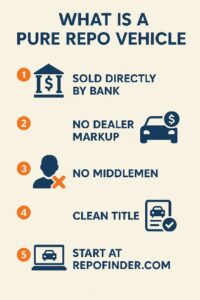
RepoFinder links directly to banks and credit unions.
>There are no salvage auctions mixed in.
>There are no insurance total-loss cars blended in.
>There are no wholesalers hiding damage.
RepoFinder focuses on:
-
True financial repos
-
Clean titles
-
Bank-owned inventory only
-
Direct listings with no middlemen
-
Clear VIN histories
-
Safer vehicles
-
More trustworthy deals
Shoppers use RepoFinder when they want real repos, not salvage leftovers.
What Buyers Can Expect at Banks and Credit Unions
Banks and credit unions usually offer:
-
Fair pricing
-
Real photos
-
Real descriptions
-
No dealer pressure
-
Simple selling terms
-
Transparent paperwork
Most banks want the vehicle sold quickly.
This avoids storing costs.
It also reduces financial risk.
These motives benefit the buyer.
What Buyers Can Expect at Salvage Auctions
Salvage auctions offer a different experience:
-
Damaged vehicles
-
Mixed inventory
-
Strict “as-is” policies
-
Major competition from professional dealers
-
Risky title status
-
Unknown repair quality
-
No test drives
- High fees to bid and when you buy
Some buyers enjoy the challenge.
But most buyers want a safer option.
That safer option is usually the bank repo.
Questions Car Shoppers Commonly Ask
“How can I tell if a repo is a true bank repo?”
Check the seller.
If it is a bank or credit union, it is a true bank repo.
RepoFinder makes this easy because every listing is direct.
“Are bank repos always clean title?”
Most are clean, but check the VIN to be sure.
Banks rarely sell salvage units, but it can happen.
“Why do some repos look too cheap?”
Banks want quick sales.
They do not follow dealer pricing models.
“Can I inspect a bank repo?”
Yes. Most banks allow viewing.
Some allow third-party inspections.
“Do bank repos come with warranties?”
Usually no.
But they start with cleaner histories than salvage units.
“Why not just buy at Copart or IAA?”
Those sites include many damaged vehicles.
They also mix insurance loss repos with regular insurance losses. They all end up with a branded title in the end.
Shoppers do not always know which is which until it’s too late.
“Why is RepoFinder safer?”
It filters out salvage auctions entirely.
You only get links to real banks and credit unions.
| Feature | True Bank Repo | Insurance-Loss Repo |
|---|---|---|
| Reason taken | Missed payments | Accident, flood, fire, theft, or major failure |
| Title status | Usually clean | Often becomes branded later |
| Hidden damage | Low | High |
| Insurance history | Usually clean | Often totaled |
| Buyer risk | Low | High |
| Best for | Normal shoppers | Professional rebuilders |
| Where found | Banks & credit unions | Salvage auctions |
Final Thoughts
Most shoppers want safe and affordable cars.
True bank repos offer that path.
Insurance-loss repos offer cheap prices but high risk.
The difference is not small.
It affects title status, safety, and long-term value.
RepoFinder exists to remove the confusion.
It sends buyers directly to banks and credit unions.
>No salvage auctions.
>No insurance-loss traps.
>No title surprises.
If you want cleaner deals and clearer histories, true bank repos are the best choice.
And RepoFinder is the easiest way to find them.
 Are Repo Cars Cheaper Than Used Cars?