
Tag Archives: repos

Comparison of where to find repossessed cars auctions banks dealers online repos US

Where to Find Repossessed Cars, Auctions, Banks, Dealers, Online, Repos US

This entry was posted in Blog and tagged , , , on by .

TL;DR – Where to Find Repossessed Cars in the US

  • Repossessed cars are sold through banks, auctions, dealers, and online platforms

  • Banks and credit unions usually offer the lowest prices because they sell to recover loans, not to profit

  • Auctions can be risky due to fees, bidding wars, and mixed title quality

  • Dealers offer convenience but usually charge the highest prices

  • The biggest savings come from buying directly from lenders

  • Platforms like RepoFinder.com help buyers locate clean-title repos sold directly by banks, avoiding dealer markups and auction fees

repo car for sale at a credit union

Where to Find Repossessed Cars, Auctions, Banks, Dealers, Online, Repos US

If you’re searching for where to find repossessed cars auctions banks dealers online repos US, you’re likely trying to answer one simple question:

Where can I buy a repossessed car without overpaying or taking on unnecessary risk?

Repossessed cars are sold across the United States every day, often at prices below traditional used-car listings. But not all repo sources are equal. Some favor experienced buyers. Others quietly add fees. Some sell clean, drivable vehicles. Others sell damaged or salvage cars.

This guide breaks down where repossessed cars actually come from, how auctions, banks, dealers, and online platforms compare, and what buyers should know before choosing a source.


What Is a Repossessed Car?

A repossessed car is a vehicle taken back by a lender after missed loan payments. The lender may be a bank, credit union, or auto finance company. Once repossessed, the lender’s goal is not to make a retail profit – it’s to recover the remaining loan balance efficiently.

Because lenders are not car dealers, repossessed vehicles are often priced to sell rather than priced for maximum margin.


Where to Find Repossessed Cars Auctions Banks Dealers Online Repos US

In the US, repossessed cars are typically sold through four main channels:

  1. Banks and credit unions

  2. Auto auctions

  3. Dealerships

  4. Online repo listing platforms

Each option comes with trade-offs in price, risk, and transparency.


Bank and Credit Union Repossessed Cars

Why Banks Sell Repossessed Cars

Banks and credit unions are not in the business of holding vehicles. Cars depreciate, require storage, and create liability. As a result, lenders typically want repossessed vehicles sold quickly and cleanly.

This is why many bank repos are:

  • Priced below market value

  • Sold as-is

  • Offered without dealer markups


Where to Find Bank Repo Cars

Bank repos are often harder to find than auction cars because banks don’t advertise aggressively. Common sources include:

  • Individual bank and credit union websites

  • Local branch listings

  • Regional asset-sale pages

  • Online directories that point buyers directly to lenders

Some online platforms specialize in organizing these listings in one place, making it easier to locate repos being sold directly by financial institutions rather than resellers.


Pros and Cons of Buying from Banks

Pros

  • No dealer markup

  • No auction bidding pressure

  • Usually clean title repos

  • Clear ownership history

Cons

  • Limited inventory at any given time

  • Vehicles sold as-is

  • Inspection availability varies

For buyers focused on value rather than convenience, bank repos are often among the best-priced options.


Repossessed Car Auctions in the US

Auctions are one of the most visible answers to where to find repossessed cars auctions banks dealers online repos US, but they also carry the highest learning curve.


Public vs Dealer-Only Auctions

  • Public auctions allow anyone to bid

  • Dealer-only auctions require a dealer license

Most large wholesale auctions are not open to the public, even though many websites blur that distinction.


Types of Repos Sold at Auctions

  • Bank and finance company repos

  • Government and fleet vehicles

  • Insurance and salvage vehicles

It’s important to understand that not all auction repos are clean-title vehicles. Many auctions mix repos with damaged or salvage cars, which can confuse first-time buyers.


Risks of Buying at Auction

  • No test drives

  • Limited inspection windows

  • Buyer premiums and fees

  • Competitive bidding against professional dealers that drives prices up

  • Salvage auctions primarily sell insurance write-off vehicles that may show a “clean title” until you go to register it and find out the title is now marked as branded.

Auctions can work sometimes for experienced buyers but often surprise newcomers with added costs and risk.


Buying Repossessed Cars from Dealers

Most dealerships do not repossess vehicles themselves. Instead, they acquire repos through auctions or directly from lenders, then resell them as used cars with an added commission and fees.


Why Dealer Repo Cars Cost More

Dealer pricing includes:

  • Transport

  • Reconditioning

  • Marketing

  • Profit margin

While dealers offer convenience and financing, repo cars sold through dealerships are typically the most expensive way to buy a repossessed vehicle.


When Dealers Make Sense

  • You need in-house financing

  • You want a warranty

  • You prefer a traditional buying experience

You’re paying for ease, not wholesale pricing.


Where to Find Repossessed Cars Online in the US

Online searches for repossessed cars have increased dramatically, but online listings vary widely in quality.


Types of Online Repo Platforms

  1. Auction-based sites

  2. Dealer inventory sites labeled “repo”

  3. Direct-to-bank listing platforms

The key difference is who actually owns the vehicle.

Some platforms simply redirect buyers to auctions or dealers. Others list vehicles being sold directly by banks and credit unions, which typically results in lower pricing and cleaner titles.


What to Watch Out for Online

Red flags include:

Legitimate repo listings should clearly identify the seller and the title status.


Best Way to Buy Repossessed Cars Without Overpaying

Buyers looking to save money generally do best when they:

  • Avoid dealer markups

  • Avoid auction bidding wars

  • Buy directly from lenders whenever possible

This is where direct-to-bank platforms quietly stand out. By connecting buyers straight to banks and credit unions – instead of acting as resellers – they reduce layers of added cost.

RepoFinder.com is one example of this approach. Rather than selling vehicles itself, it functions as a directory that helps buyers locate repossessed vehicles owned by financial institutions. Because the sale remains between the buyer and the bank, prices tend to reflect liquidation value rather than retail markup, and titles are typically clean.


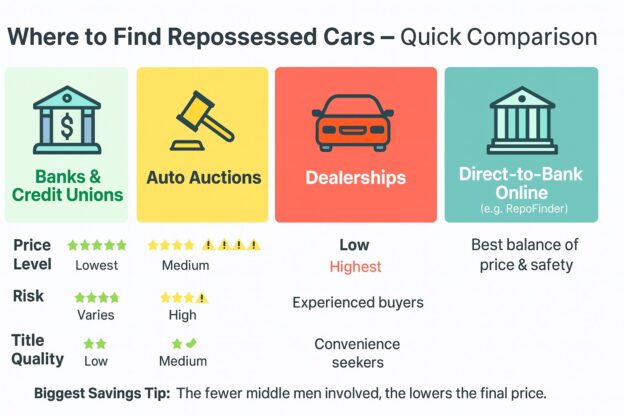
Comparing Repossession Buying Options

Source Typical Price Risk Level Title Quality
Banks & Credit Unions Low Medium Usually clean
Auctions Variable High Mixed
Dealers High Low Clean
Direct-to-Bank Online Low Medium Usually clean

The biggest savings usually come from removing unnecessary middlemen.

One reason buyers struggle to find real deals is that many “repo car” listings are actually dealer inventory or auction vehicles relabeled as repossessions. True repossessed cars are owned by banks and credit unions, and these vehicles are usually sold with clean titles because lenders avoid insuring damaged or salvage assets. Understanding who owns the vehicle matters more than where it’s listed. The closer you buy to the lender, the fewer markups and fees you’ll encounter.


Step-by-Step: Buying a Repossessed Car Safely

  1. Choose your buying source

  2. Research fair market value

  3. Confirm seller identity

  4. Verify title status

  5. Inspect when possible

  6. Complete payment and transfer

Repos can offer excellent value, but only when buyers slow down and verify details.


Common Mistakes Buyers Make

  • Assuming all repos are cheap

  • Confusing salvage auctions with bank repos

  • Ignoring fees

  • Failing to verify title status

Most bad repo experiences come from misunderstanding the source, not the vehicle.


FAQ: Where to Find Repossessed Cars Auctions Banks Dealers Online Repos US

Where to find repossessed cars auctions banks dealers online repos US?
Repossessed cars can be found through banks and credit unions, public auctions, dealerships, and online platforms that list repos directly from lenders. Each option differs in cost and risk.

Are bank repos cheaper than auction cars?
Often, yes. Auctions include competition and fees, while banks focus on liquidation.

Do repossessed cars usually have clean titles?
Most bank and credit union repos do, but buyers should always confirm.


Final Thoughts

When researching where to find repossessed cars auctions banks dealers online repos US, the smartest buyers focus less on hype and more on who is selling the vehicle.

Auctions reward experience. Dealers charge for convenience. Banks prioritize clean exits.

Buying directly from financial institutions – whether through local banks or tools that make those listings easier to find – often strikes the best balance between savings and safety.

car keys

What is the Best Way to Find Repo Cars Near Me?

This entry was posted in Repo Cars and tagged , , , on by .

Are you looking for repossessed cars for yourself or a new driver in the household? If so, you’re probably wondering where you can find these vehicles quickly, easily and affordably. More people are turning to repo cars due to the price hikes on new and used vehicles. While you’ll have to be patient and do your research, you can find repo cars at great prices – all they may need is a bit of TLC! 

Here are some tips for finding repo cars, trucks, SUVs and recreational vehicles near you. 

Used Car Dealerships 

There is a possibility that you can find a repo with a local dealership. BUT…dealerships often advertise repos to get you in the door and thinking you’re getting a great deal. But really, these repos are no different than used cars. They’ve been bought at an auction, cleaned up and had repairs made, which means they cost more. 

That’s not to say that buying a repo from a dealership is a bad deal, but rather that you’re going to pay a markup. Dealerships generally do not sell true repos. 

Banks and Lenders

Some banks and credit unions sell their repo inventory directly to the public at certain times of the year. You may be able to find these vehicles being advertised in local newspapers or on bank and credit union websites. Lenders list basic details about the vehicles they have so that people can submit their bids. 

While it’s actually advantageous to go through a bank or lender, it can be hard to track down which banks are selling their repo inventory. Wouldn’t it be nice if there was a website that had a list of the banks and credit unions selling repos? (Hint: There is!) 

Public Auctions 

Not all auctions sell vehicles to the public. Many require bidders to have a dealer’s license, which is a license that allows dealers to purchase cars from auto auctions on a large scale. But, if you can find an auction that sells to the public, you can certainly check out their options. However, be prepared for cars that have been poorly maintained, as well as lots of bids. 

RepoFinder 

RepoFinder.com is an online directory that has the links to banks, lenders and credit unions selling repossessed vehicles. You can easily find banks in your area by clicking on your state. Pictures and information about each vehicle are provided for free. This way, you can shop around and place a bid when you’re ready. 

All repos listed on these websites are available to the public. The lender will tell you how to place a bid, and many are willing to negotiate. You may even be able to get financing through the bank itself – this is their business after all, NOT selling cars! To find a repo in your price range, browse RepoFinder today

online car shopping for repos

Your Top 5 Questions On Buying a Repo Car…Answered!

Thinking about buying a repossessed vehicle? This is a great way to save money while getting a reliable car with all the latest features. But chances are, you probably have a few questions about what the process entails and how to find the best deals. We’re here to help! 

Shopping for repo cars is easy, but it helps to be an informed buyer. This is the best way to ensure you bid on the right vehicles and walk away with something safe, reliable and reasonably priced. 

Below are the top five questions we hear from people interested in buying repos, along with our responses.

1. What are repossessed cars, exactly? 

When people can’t afford to make their car payments, the bank that gave them the loan can take the car back. Some cars are returned voluntarily while others are taken by the repo man. Based on 2021 data, there are over 2 million repossessions every year. While there are many repos out there, not all are available to the public. Many repos are sold at dealer-only auctions. 

2. Should I buy a repossessed vehicle? 

Only you can make the decision as to whether or not you should buy a repossessed vehicle. However, we can tell you that there are many reasons to consider this avenue such as: 

  • Cheaper than used vehicles sold at a dealership 
  • Able to negotiate the price – repo sellers are highly motivated 
  • Quick turnaround times, especially in today’s market 
  • Save money on insurance and interest  

3. How do I know I’m getting a repo car? 

The only way to know that you’re getting a true repo is by buying directly from a bank or credit union. Dealerships sometimes advertise repos, but this isn’t really true. Usually in these cases, the dealer purchased the car at a discount, cleaned it up and is now selling it for a profit. 

You can research repos in your local area or use a site like RepoFinder to find repossessed cars, pickup trucks, SUVs and motorcycles. RepoFinder gives you a much better selection and you can feel good knowing that all transactions are between you and the seller – no middleman. 

4. What concerns should I have when buying a repo? 

The hard thing about repo cars is that you don’t know how well the previous owner took care of them. Some repos are in great condition while others need some work. The key is to place a smart bid that leaves room to afford necessary repairs. 

We always recommend that buyers do their research, ask questions and schedule an inspection before signing the paperwork. Avoid overbidding as well. Even though we’re experiencing a car shortage, you shouldn’t pay more than you need to. Patience goes a long way in this industry! 

5. Why should I shop for repos at RepoFinder? 

RepoFinder lets you buy repossessions directly from local banks and credit unions. Our site is free to use, though you can upgrade to RepoFinder Pro for just $4.95 a month – cancel anytime. We add new repos on a regular basis and make it easy to research and place bids directly on our website. 

Don’t take our word for it – shop at RepoFinder and find affordable repos in your area. 

repo car cleaning

Car Cleaning Hacks for a Like-New Car

No matter the type or age of your vehicle, keeping it clean is a priority for most car owners. There’s just something refreshing about getting into a clean and tidy vehicle that smells just as good as the day you brought it home – if not better! 

If you recently purchased a used vehicle, here are some car cleaning hacks you’ll want to follow. We recommend these tips to customers who purchase repossessed vehicles from us. Many of the cars we sell are in great condition but they still require basic maintenance. The good news is that these tips will save you from costly detailing services. 

Use a Makeup Brush to Clean the Vents 

We recommend keeping a makeup brush in your car to clean out the air vents. These vents get dusty and this dust blows all over the car when you’re running your heat or air. Keep a makeup brush stashed away in your glove box and use it to remove dust from the air vents. 

Squeegee Pet Hair off the Seats

If the previous owner had a pet, there’s a good possibility that you’ll find pet hair all over the seat. As sticky as this hair can be, you can get it off your seats using water and a squeegee. Fill up a spray bottle with water, mist the seats and run a squeegee over the upholstery. This will remove all the pet hair. 

Use Cooking Spray to Remove Bugs 

If there’s a ton of bugs on your repo car, use a can of cooking spray to get them off. This is a lot better than scrubbing the bugs off, as this can damage the paint job. Be sure to let the cooking spray sit for a few seconds and use a microfiber cloth to wipe off the bugs. 

Deep Clean the Upholstery

To take things a step further, you can deep clean the seats in your car using a vinegar and baking soda paste. Mix the two ingredients together until it forms a paste. Scrub this paste into your seats and then rinse it out. It will remove stains and leave your car smelling fresh and clean! 

Use Magic Erasers on Surfaces 

Magic Erasers are cheap and easy to use. Keep some on hand to scrub away dirt, dust and grime. These sponges are especially effective on plastic and vinyl surfaces, though you will want to be careful on leather as it can scratch. You can also use a toothbrush to clean out dirt from nooks and crannies. 

Wax Your Car 

Getting your car waxed a couple of times a year goes a long way in keeping it clean. When you go through the car wash, dust and dirt will lift away. Waxing your vehicle also prevents nicks and chips from forming in the paint. To save money, you can wax your car yourself using basic ingredients like dish soap and hair conditioner. 

Bring Home a Repossession Today 

These are just some of the ways you can get your repo car looking like new! Most repos need a little TLC when you first bring them home because they haven’t received much attention from their previous owners. The good news is that all of these hacks are cheap, easy and use basic ingredients from the home. To shop for repossessions, click on your state on our home page and search though the available vehicles. 

car inspection

Are Repossessed Vehicles Safe to Buy?

No matter what type of vehicle you’re buying, one of the most important things is that it’s safe and reliable. Driving away with a new or used car from a dealership offers a certain level of comfort, as you know the vehicles have been properly inspected. And if there is something that ends up being wrong with the car, you have a warranty from the dealership and the car manufacturer. 

But what happens when you buy a repossessed vehicle from a bank, credit union or auction? These cars are rarely inspected or looked at before going to a new owner. So are they safe to buy? Let’s find out! 

Repossessions ARE Safe – But it Pays to be a Smart Consumer

Repossessed cars are generally very safe, but as with any vehicle purchase, you’ll want to do your research and be a smart consumer. Some repossessed cars arrive in great condition and others require some TLC, which is usually reflected in the price.

As you look at repo cars to buy, find out as much information as you can about the vehicle online. Pay attention to the make and model, odometer reading and transmission type. Most banks and credit unions include lots of pictures so that you can check out the condition of the car’s interior and exterior. They want to sell their inventory quickly so they provide as much information as possible. 

Don’t Forget: Bring Along Someone to Inspect the Vehicle

Before you sign anything, inspect the vehicle to make sure you know what you’re getting. You can do this yourself if you feel comfortable, otherwise bring along someone who knows cars. You can expect repossessions to need some TLC, but you should trust the overall safety of the car. 

For liability reasons, most banks and credit unions do not allow potential bidders to test drive their vehicles. But, most allow (and even encourage) inspections and will let you start up the engine to make sure it runs.

Find a Safe Repo at RepoFinder.com 

As long as you do the right research and inspect the vehicle, you should have no trouble finding a safe, reliable repo at a great price. RepoFinder.com has a huge inventory of repossessed vehicles from various banks and credit unions in your area. We provide as much information as possible, including plenty of images to help you make an informed decision. Find your new repo vehicle with us today! 

teen driver

New Teen Driver in the House? Get Them a Bank Owned Vehicle!

If you have a teenager in the home and they want a car, you have a few options to consider. You can buy the car for them, let them pay for the car on their own or do a combination of both. While it may seem tempting to go out and buy your teen a new car, especially if you have the money, it may not be the best option. 

Something else to consider is buying your teen a bank owned car. These vehicles have been repossessed from their previous owners and are now owned by the banks. However, the banks are in the market to lend money – not sell vehicles. What does this mean for you? You can get a decent first car for a fraction of what you’d pay at the dealership. 

Let’s look at the benefits of buying your teen a repossessed car

Honest, Affordable Prices 

Car dealerships drive people in with attractive ads, but they’re often deceptive. They might tease low payments, when in reality, the payments are temporary. Or they might show prices after a large down payment or low rates that only go up to a certain amount. Whatever the case, once you get to the dealership, the prices will be more than you thought.

Bank owned vehicles are affordable for a couple of reasons. First, the banks are highly motivated sellers that want to recoup some of their losses. Second, these cars are sold as-is. Whatever problems they come with are your responsibility. In return, the banks offer steep discounts to make these vehicles attractive. 

Low Monthly Payments 

When you pay less for a vehicle, the monthly loan payments will be lower as well. If your family can’t afford another car payment right now, a repo is a great option because you’ll pay far less than if you were to shop at the dealership. In fact, many repos are cheap enough that you can buy them outright without an auto loan. This is a great option for teens that have a nest egg saved up. 

Already Used and Loved 

Repossessions are previously owned so they’ve already been driven, used and loved. Even though your teen may feel that something new and shiny is best, this is rarely the case from a practical standpoint. Kids are kids and first-time cars often take a beating. 

The nice thing about used cars is that they’ve already been loved. You don’t have to worry too much about dents and dings. And your teen won’t have the pressure of keeping the car in pristine condition – they can focus on their driving experience instead. 

Find Your Teen Driver a Car at RepoFinder

RepoFinder has a huge database of repossessed cars that are perfect for new drivers. You can use our search tools to find a car that offers the features your child needs to be safe on the road while saving money and keeping payments low. Shop with us today and see what you can find for your teen driver! 

two people in vehicle

People are Attached to their Cars. Banks Aren’t. Negotiate a Great Deal on a Bank-owned Car.

This entry was posted in Repo Cars and tagged , , , on by .

Some people have an emotional attachment to their cars. They give them a name, gender and even a personality. Even though it may sound silly to have a personal relationship with a vehicle, it’s not uncommon. According to one study, 70 percent of respondents admitted to feeling “very attached” or “somewhat attached” to their cars. 

There are a number of reasons why people get attached to their vehicles. For example, people often go through major milestones with them – weddings, road trips, new babies. Some view their vehicle as a financial investment, while others have had them passed down. Because of this emotional attachment, 36 percent of people say they want their car to go to a good home. 

Don’t Want to Deal with a Sentimental Owner? Buy a Repo! 

While there’s nothing wrong with having an emotional attachment to your vehicle, things are harder if you’re on the other side. If you’re looking to buy a vehicle that someone is attached to, they may want to charge more because of this emotional investment. They may also be insulted if you try to negotiate. 

The good news is that you can purchase a used vehicle at a great price without having to deal with a sentimental owner. Bank-owned vehicles are in possession of banks and lenders – they were taken from owners who could no longer afford them. 

And trust us, the banks have no emotional attachment to these vehicles. They make money off lending money, not keeping cars. This gives you the upper hand – you can negotiate a better deal and get a more fair, unbiased breakdown of the vehicle’s condition. 

Tips for Negotiating with the Banks 

Buying a bank-owned vehicle is a great option if you’re looking for a fast and easy car sale. Here are some tips for negotiating a great deal on a repo. 

  • Knowledge is power. Know everything you can about the vehicle so that you can negotiate fairly. 
  • Think about financing early. Having pre-approved financing makes you a stronger candidate. The bank will be more willing to close the deal.
  • Read the paperwork. Make sure that the seller isn’t slipping in any additional fees or add-ons.
  • Be patient. If you need to walk away from the deal, that’s ok. Even though there are a lot of bank-owned vehicles, buying one of these cars is a process that requires patience. 

RepoFinder.com has a full list of bank-owned vehicles like cars, trucks, boats, ATVs, motorcycles and more. When you visit our site, click on your state and find the repos available in your area. It’s free, so find an affordable bank-owned car today! 

line of cars

Pros and Cons to Buying Bank Owned Vehicles

A bank-owned car can be a great deal – or a total nightmare. As with other purchases, it’s important to do your research and be a smart shopper. When you’re careful about your purchase, you can take home a safe, reliable car for a fraction of the cost. And, banks have more than just cars. Many people turn to bank-owned inventory when buying pickup trucks, boats, ATVs, RVs and small aircraft. 

Below you’ll find the pros and cons to buying bank-owned vehicles, and then you can decide if this route is right for you. 

Pros of Buying Repossessed Vehicles 

When the owner of a vehicle doesn’t make their loan payments, their vehicle can be taken away by the bank. Usually this happens after a few months of defaulted payments, but it can happen even sooner than that. Some people assume that repos are always old, beat up cars that no one wants, but it’s often the new cars that people can’t afford. 

Here are the pros to buying bank-owned vehicles: 

  • Get a great deal on a decent vehicle. Banks and lenders want a quick sale to reduce their loan loss, which is why they price their inventory low and are willing to negotiate. 
  • Shop a wide selection. Cars and trucks are taken away all the time from their owners. Banks end up selling them to dealerships, the general public or auction sites, leaving you to shop an impressive selection of cars, trucks, SUVs and more. 
  • Fast turnaround. While you do need to be patient when shopping for repos, the process usually moves quickly when you find something you like. Banks and lenders want these vehicles off their lots as soon as possible. 

Cons of Buying Bank-Owned Cars 

There are some disadvantages to buying repossessed vehicles, which is why they aren’t for everyone. Here are some cons to be aware of. 

  • Lack of test drives. It’s possible that you won’t be able to test drive the car before you buy it. This can be a problem if there are hidden issues. To offset this risk, be sure to look at the vehicle’s pictures, get a condition report and schedule an inspection. 
  • As-is purchase. If you buy a repo and decide you don’t like it, you can’t bring it back. You’re stuck with it because all repos are “as-is” purchases. That said, some vehicles still carry their original warranty, which is passed down to the new owner. 
  • Unclear background. Banks usually send out a third-party to repo vehicles, so you probably won’t know a lot about its background. The good news is that you can find most of this information online, as auction centers must disclose this information to the buyers. 

As you can see, there are clear pros and cons to buying bank-owned cars, trucks and RVs. RepoFinder.com has a vast selection of vehicles that are in good condition and have low mileage. Take a look and see what types of vehicles you can find in your price range – it’s free! 

wheels

AWD vs 4WD: What’s the Difference?

When shopping for used cars, there are a number of features to pay attention to. An important one is all-wheel drive (AWD) and four-wheel drive (4WD). Years ago, if you wanted four driven wheels, you were limited to a small selection of vehicles. Today, this is not the case. Close to half of all vehicles sold in the U.S. have either AWD or 4WD. 

So what’s the significance of having all-wheel drive or four-wheel drive? Is one better than the other? We’ll answer your questions in this article. 

What is All-Wheel Drive? 

All-wheel drive systems send power to both the front and rear wheels. Some AWD vehicles have all four wheels driving continuously, while others operate in mostly two-wheel drive. If you need the extra traction, the car will automatically send power to all four wheels. 

The benefit to AWD is that you don’t have to make any decisions about your wheels. Either the wheels are driven the whole time, or the system will drive with two and send power to all four if it senses a loss of traction. This allows you to drive smoothly in all types of weather conditions and terrains. 

What is Four-Wheel Drive? 

Four-wheel drive systems have become incredibly sophisticated over the years. They can handle more off-road use and are found in a wide range of vehicles, including luxury cars. However, 4WD is robust and remains most popular for ruggedness and pulling power. 

Like AWD, 4WD comes in two types: full-time and part-time. With full-time 4WD, the wheels receive power continuously. With part-time 4WD, only the two wheels move. If you need to send power to the other wheels, you’ll need to make the decision and push a button or shift the lever. 

Which is Better: AWD vs. 4WD? 

There is no best option for everyone. It all depends on where you live and what types of driving conditions you encounter. Before buying a repossession in your area, think about how you plan to use the vehicle. Will you be going off-roading with your new truck? Do you drive in snow and ice in the winter? Is fuel economy important to you?

We recommend AWD for many drivers because it delivers traction in the right conditions, offers better fuel economy and can be found in a wide range of vehicles, including luxury cars and SUVs. On the other hand, if you live in a remote area, work in extreme conditions or enjoy off-roading, we suggest 4WD. It’s better equipped to handle these rugged conditions. 

Find Your AWD or 4WD Repo Today 

When you shop for repossessed cars and trucks with RepoFinder, we try to put AWD or 4WD in the vehicle’s description. This way, you can easily see what system each vehicle comes with. It’s a quick and easy way to narrow down your options, especially if you prefer one system over the other. View a full list of repos in your area by visiting RepoFinder.com today. 

person driving vehicle

What Steps Should I Follow When Buying a Repossessed Vehicle?

If you’re shopping for an affordable vehicle in decent condition, you don’t have to settle for a pricey used car. Another option is a repossessed vehicle, or one that was taken away from its previous owner for defaulting on the loan

The nice thing about shopping for repos is that they don’t have any upcharges. Buying a used car from a dealership is still expensive because it has been cleaned, repaired and inspected by a mechanic. Repo cars are sold as-is, which is reflected in the price. 

Below are the steps you should follow when buying a repossessed car, truck or other vehicle. 

Choose who you are going to buy from.

There are a number of ways you can purchase a repossessed vehicle:

  • Lenders. Buying directly from a lender is the best way to get a great deal. Credit unions and banks want to get rid of repos and recoup their losses, passing on the savings to you. For a complete list of repos in your state, visit RepoFinder.com.
  • Repo reseller. The benefit to working with a repo reseller is that they generally have some standard for the condition of vehicles they sell. You will pay more for these vehicles, but you can expect a better car. 
  • Auctions. There are all types of auctions online, though the majority are for used car dealers, not individual buyers. However, if you happen to find an online auction, make sure you register online and take a look at their inventory. 
  • Used car dealers. Used car dealerships do sell repos, but keep in mind that they will be more expensive. This is because the dealerships inspect the vehicles and fix them up before selling. 

Determine your budget. 

It’s important to establish your budget in advance. Most repos need some type of maintenance, so this will need to be factored into your budget. If you use all of your money to buy the car, you won’t have enough to make essential repairs. Like used cars, repos come in all price ranges. 

Research the vehicles you want. 

To narrow down your search online, research the best vehicles for your needs. Consider what features are most important to you, such as special cameras, sensors, tire pressure alerts and seating. Also research what car makes/models are most reliable. Generally speaking, repo shoppers do best with reliable, low maintenance cars that hold their value. 

Place your bid.

Once you find a repo that fits your criteria, you can make an offer on it. We also recommend having financing in place, as this shows that you are a serious buyer. 

Nearly all repo sites require you to be a member, which is why it’s important to choose how you’re going to buy your vehicle first. For example, when you sign up for RepoFinder Pro for just $4.95 a month, you get full access to our repo list and can place bids. 

Inspect the vehicle.

If the seller accepts your bid, you can purchase the vehicle. We strongly recommend inspecting the repo before signing anything. You probably won’t be able to test drive it, but you can look at it for an overall assessment. Once this is done, you can sign the paperwork and take your vehicle home! 

Buying a repo is fairly straightforward, though it does require more diligence on the buyer’s part. You won’t have a car salesperson showing you around and selling you vehicles, which some look at as an advantage, but you will be on your own. Use the online tools to your advantage, research the cars you’re interested in and inspect the repo before signing anything and you should be just fine.