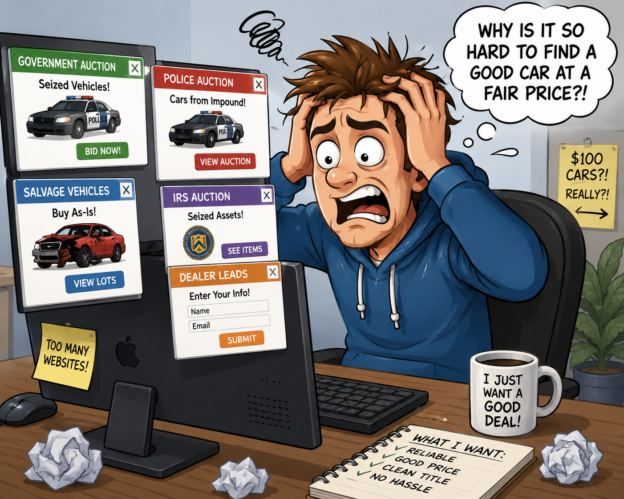


Searching for a repossessed vehicle can be a great way to save money, but buyers should know how to identify misleading listings, hidden fees, and outright repo car scams.
Many websites use phrases such as “repo cars” or “bank repossessions” even when the vehicles are actually dealer inventory, insurance auction inventory, salvage vehicles, or listings offered through third-party brokers.
Quick Answer: How to Avoid Repo Car Scams
The safest way to buy a repossessed vehicle is to verify the seller, confirm the VIN and title status, understand every fee, inspect the vehicle when possible, and work directly with the selling bank or credit union.
- Verify the seller: Confirm that the bank, credit union, or authorized seller actually owns the vehicle.
- Call independently: Contact the institution using the phone number on its official website.
- Check the vehicle: Verify the VIN, title status, location, availability, and sale terms.
- Know the total cost: Ask about buyer premiums, broker fees, storage charges, document fees, and membership fees.
- Avoid suspicious payments: Never send gift cards, cryptocurrency, or rushed payments to an unverifiable seller.
- Know the difference: Bank repos are generally loan-default vehicles, not insurance total-loss vehicles.
Bottom line: Buying directly from a verified bank or credit union can reduce the risk of fake listings, misleading “repo” advertising, unnecessary middlemen, and unexpected fees.
What This Guide Covers
- How to recognize fake or misleading repo listings
- Why buying directly from a bank may reduce risk
- The difference between repossessed and salvage vehicles
- Hidden auction and broker fees to watch for
- How to verify a lender, VIN, title, and payment instructions
- Questions to ask before placing a bid or sending money
Bank Repo vs. Salvage Auction Vehicle
| Bank or Credit Union Repo | Salvage Auction Vehicle |
|---|---|
| Usually repossessed because of missed loan payments | Often declared a total loss by an insurance company |
| Clean titles are common, but should always be verified | Salvage, rebuilt, or branded titles are common |
| The lender or its authorized seller owns the vehicle | The seller may be an insurer, auction company, broker, dealer, or third party |
| Buyers may be able to communicate directly with the financial institution | Buyers frequently work through an auction platform or broker |
| Fewer middlemen may mean fewer added fees | Buyer premiums, broker fees, membership fees, and other charges may apply |
| Vehicle condition still varies and should be inspected | Significant collision, flood, theft, fire, or mechanical damage may be present |
Important: Not every auction vehicle has a salvage title, and not every repossessed vehicle is problem-free. Always verify the title, condition, fees, and seller before purchasing.
RepoFinder Insight
Over tens of thousands of repossessed vehicles listed through RepoFinder, non-clean-title vehicles have been exceptionally rare. Buyers should still verify the title directly with the selling lender, but bank and credit union repossessions generally represent a very different market from insurance salvage auctions.
RepoFinder helps buyers locate current bank and credit union repossessions across the United States. Buyers can search by state, vehicle type, make, model, and price before contacting the selling institution directly.
What Is a Repo Car Scam?
A repo car scam does not always involve a completely fake vehicle. Some scams and misleading sales practices are more subtle.
Common problems include:
- Websites advertising ordinary dealer inventory as repossessed vehicles
- Fake listings copied from legitimate bank, dealer, or auction websites
- Requests for payment before the seller or ownership can be verified
- Hidden buyer premiums, broker fees, membership charges, storage fees, and document fees
- Vehicles advertised as clean-title repos when they actually have salvage or rebuilt titles
- Old listings that remain online after the vehicle has already sold
- Sellers who refuse to identify the bank, credit union, auction company, or legal owner
Before paying a deposit or placing a bid, determine exactly who owns the vehicle, who is conducting the sale, and where your payment will be sent.
The Anatomy of a Repo Car Scam
Unusually low price
↓
Immediate payment demanded
↓
Seller will not identify the bank or owner
↓
VIN, title, or location cannot be verified
↓
Gift card, cryptocurrency, or suspicious wire transfer requested
↓
Walk away
One warning sign does not automatically prove that a listing is fraudulent. However, several warning signs appearing together should stop the transaction until everything can be independently verified.
Why Buying Directly From a Bank Can Reduce Risk
Banks and credit unions usually repossess vehicles because borrowers stopped making loan payments. That is very different from an insurance company declaring a damaged vehicle a total loss.
Because of this distinction, lender-owned repossessions frequently represent a different class of inventory than vehicles found at salvage-focused auctions.
Potential advantages of buying directly from a bank or credit union include:
- A clearer chain of ownership
- Direct communication with the institution selling the vehicle
- Fewer middlemen involved in the transaction
- No dealer markup added by a traditional used-car dealership
- Clearer bidding or purchasing instructions
- Clean titles in the overwhelming majority of lender-direct listings
Buyers who are unfamiliar with the process can review our step-by-step guide to buying a repossessed car before contacting a lender or submitting a bid.
Repo Cars Are Not the Same as Salvage Cars
A repossessed vehicle and a salvage vehicle are not the same thing.
A repossessed vehicle is generally taken back by a lender after a borrower defaults on a loan. A salvage vehicle has usually been declared a total loss because of collision damage, flooding, theft recovery, fire, or another serious event.
How a Bank Repo Usually Reaches the Market
Borrower defaults on the loan
↓
The lender repossesses the vehicle
↓
The bank or credit union offers it for sale
↓
The buyer contacts the lender or authorized seller
How a Salvage Vehicle Usually Reaches the Market
The vehicle is damaged, flooded, stolen, burned, or involved in an accident
↓
An insurer declares it a total loss
↓
The title may be branded salvage or rebuilt
↓
The vehicle is offered through a salvage auction or broker
Some auction websites display repossessions alongside salvage, damaged, dealer, and insurance inventory. Buyers should never assume that every vehicle advertised on a “repo” or auction website is a clean-title bank repossession.
Always review the title information and identify the actual seller before bidding. RepoFinder’s directory of banks that sell repo cars can help buyers locate legitimate lender-direct sources.
Looking for a Legitimate Bank Repo?
Search current repos by state, vehicle type, make, model, and price. Review the listing, identify the lender, and confirm all details directly with the selling institution.
Seven Repo Car Scam Warning Signs
1. The Seller Will Not Identify the Legal Owner
A legitimate seller should be able to explain whether the vehicle is owned by a bank, credit union, dealer, auction company, insurance company, or private party.
Be cautious when the seller avoids basic ownership questions or claims that the vehicle owner must remain confidential.
2. The Price Is Far Below Market Value
Bank repossessions can be competitively priced, but an unbelievable price should trigger additional verification.
Scammers often use unusually low prices to create urgency and convince buyers to send money before investigating the listing.
3. The Seller Demands Unusual Payment Methods
Be extremely cautious if a seller demands payment through:
- Gift cards
- Cryptocurrency
- Money-transfer apps sent to an individual
- Wire transfers to an unrelated business or person
- An unfamiliar or unverifiable escrow company
Verify payment instructions using contact information published independently by the bank or credit union. Do not rely solely on the phone number or email address provided in the listing.
4. Hidden Fees Appear Late in the Process
The advertised price may not reflect the actual amount you will pay.
Depending on the seller or platform, additional costs may include:
- Buyer premiums
- Broker fees
- Membership fees
- Internet bidding fees
- Document fees
- Storage fees
- Transportation charges
Ask for the complete purchase price and fee schedule before placing a bid. Buying directly from a lender can often reduce the number of third parties and added charges involved in the transaction.
5. The Title Status Is Unclear
Never assume that a vehicle has a clean title simply because it is described as repossessed.
Ask the seller:
- Is the title clean, rebuilt, salvage, or branded?
- Does the title have any remaining liens?
- Which state issued the title?
- When will the title be delivered?
- Are there any title-processing fees?
When possible, verify the vehicle identification number before completing the purchase.
6. You Cannot Inspect or Verify the Vehicle
Some repossessions are sold as-is, and inspection opportunities may be limited. However, the seller should still provide enough information for you to verify that the vehicle exists and that the institution has authority to sell it.
Be suspicious when a seller refuses to provide a VIN, vehicle location, additional photographs, inspection details, or verifiable contact information.
7. The Seller Pressures You to Act Immediately
Repo inventory can sell quickly, but pressure should never replace verification.
Scammers often create artificial urgency by claiming that several buyers are waiting, the price expires within hours, or immediate payment is required to reserve the vehicle.
Take enough time to confirm the seller, title, fees, vehicle condition, and payment instructions.
How to Verify a Bank Repo Listing
Use the following process before placing a bid, sending a deposit, or transferring money.
- Identify the selling institution. Determine whether the seller is a bank, credit union, auction company, dealer, broker, or private individual.
- Visit the institution’s official website. Confirm that the repo listing or sales department is connected to the institution.
- Call the institution directly. Use a phone number obtained from the institution’s official website, not only the number shown in the advertisement.
- Verify the VIN. Confirm that the VIN matches the vehicle, title documents, and any available history report.
- Confirm the title status. Ask whether the title is clean and whether any liens or brands remain.
- Request the complete fee schedule. Calculate the total cost before bidding.
- Review the sale terms. Understand deposits, deadlines, accepted payment methods, inspection rules, transportation requirements, and refund policies.
RepoFinder’s nationwide repo search allows buyers to search by state, vehicle type, make, model, and price before contacting the selling institution directly.
Questions to Ask Before Buying a Repossessed Vehicle
Ask these questions before making an offer or placing a bid:
- Who currently owns the vehicle?
- Is the seller a bank or credit union?
- Is the title clean?
- Are there any liens, title brands, or ownership issues?
- What fees will be added to the purchase price?
- Can the vehicle be inspected before purchase?
- Does the vehicle start, run, and drive?
- Is a vehicle history report available?
- Is the vehicle sold as-is?
- What payment methods are accepted?
- When will the title be released?
- How quickly must the vehicle be removed?
Why RepoFinder Exists
RepoFinder was created to make it easier for buyers to locate bank and credit union repossessions without searching hundreds of separate financial institution websites.
Many large vehicle platforms focus on salvage inventory, dealer listings, insurance auctions, or broker-assisted bidding. RepoFinder focuses primarily on helping the public discover vehicles offered by banks, credit unions, and other financial institutions.
The goal is not to purchase vehicles and resell them at a markup. The goal is to help buyers identify legitimate lender-direct opportunities and connect with the institution or authorized seller handling the transaction.
Why RepoFinder Is Different
RepoFinder is not a vehicle dealer and does not purchase repossessed vehicles to resell at a markup.
RepoFinder provides access to:
- Banks and credit unions that sell repo cars
- Current repossessed vehicle inventory
- State-specific repo resources
- Cars, trucks, SUVs, RVs, boats, motorcycles, trailers, and equipment
- Educational resources for repo buyers
This lender-direct approach helps buyers identify who is selling the asset and understand the purchasing process before committing money.
Final Repo Scam Prevention Checklist
Before buying any repossessed vehicle, confirm the following:
- The seller’s identity has been independently verified
- The bank or credit union confirms the vehicle is available
- The VIN matches the listing and available paperwork
- The title status has been confirmed
- All buyer, broker, auction, storage, transportation, and document fees are known
- The payment instructions are legitimate
- The vehicle condition has been reviewed or inspected
- The complete sale terms have been read carefully
Buying a repossessed vehicle can be an excellent way to find value, but the lowest advertised price is not always the safest or least expensive option.
Verifying the seller, buying directly from a legitimate financial institution, and understanding the full transaction can help you avoid repo car scams and expensive surprises.
Frequently Asked Questions About Repo Car Scams
Are bank repo cars legitimate?
Yes. Banks and credit unions regularly sell vehicles they repossess after borrowers default on their loans. Buyers should confirm that the listing is connected to the financial institution and verify all payment instructions independently.
Are repossessed vehicles usually clean title?
Bank and credit union repossessions commonly have clean titles because they were repossessed after loan defaults rather than declared total losses by insurers. However, buyers should always confirm the exact title status before purchasing.
How can I tell whether a repo listing is fake?
Warning signs include an unverifiable seller, refusal to provide a VIN, an unusually low price, pressure to pay immediately, suspicious payment methods, and payment instructions that cannot be confirmed through the financial institution’s official website.
Can anyone buy a repossessed vehicle directly from a bank?
Many banks and credit unions sell repossessed vehicles directly to the public, although sale procedures vary. Some use fixed prices, some request sealed bids, and others use an authorized auction company.
Are all repo auctions scams?
No. Many legitimate auctions sell repossessed vehicles. The important distinction is understanding who owns the vehicle, whether the title is clean or branded, what fees apply, and whether a broker or other middleman is involved.
Why are some repossessed vehicles less expensive?
Financial institutions usually want to recover the unpaid loan balance and remove repossessed assets from their books. They are not traditional dealers preparing vehicles for retail resale, so prices may be competitive. Condition, demand, loan balance, and sale method all affect pricing.
Should I inspect a bank repo before buying it?
Yes, whenever inspection is permitted. Repossessed vehicles are commonly sold as-is, and the lender may have limited information about their mechanical condition or maintenance history.
Continue Learning About Bank Repossessions
- How to Buy a Repossessed Car
- Banks That Sell Repo Cars Directly to the Public
- Search Current Bank and Credit Union Repossessions
Search Current Bank and Credit Union Repossessions
Search current bank and credit union repos by state, vehicle type, make, model, and price. Contact the selling lender directly whenever possible and always verify the title, condition, availability, fees, and sale terms before purchasing.
RepoFinder provides vehicle discovery and educational information. Vehicle availability, condition, title status, pricing, fees, and purchasing requirements must be confirmed directly with the selling institution or authorized seller.