


Want to skip auctions and browse repo cars directly from banks?
Unfortunately, a lot of big players in the automotive sales arena are using the term “repo car” to bait-and-switch buyers into buying “salvage cars”. These are large auction houses that primarily sell wrecked and damaged vehicles. Sure they may sell a few repos from time-to-time, but a deeper dive shows they’re a lot heavier on smoke and mirrors than actual repo car deals.
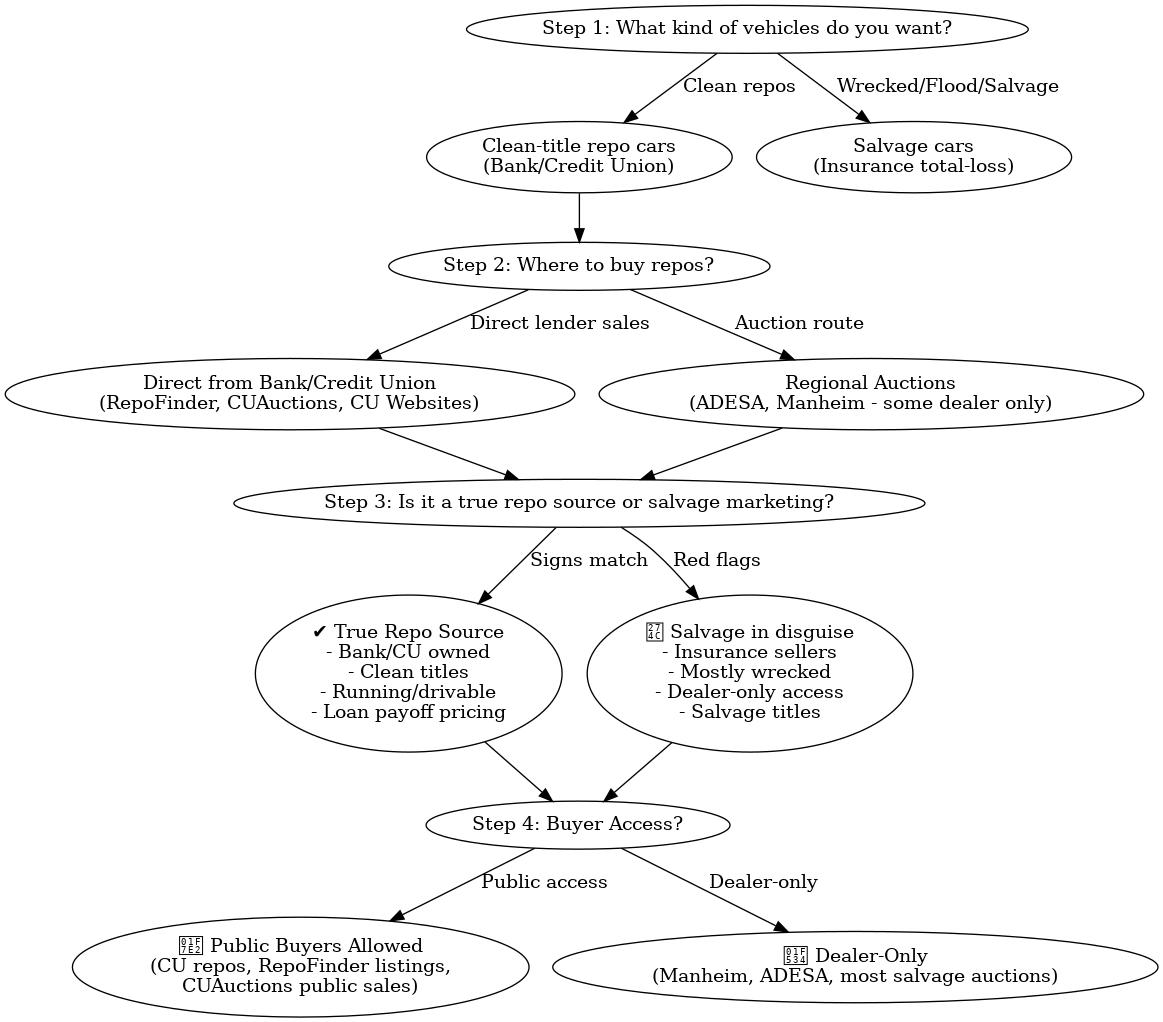
Here’s a repo car buyers decision tree to help you sort this all out:
🧭 Repo Car Buyer’s Decision Tree
1: What kind of vehicles are you looking for?
-
🚗 Clean-title repos (bank/credit union repos) → Go to Step 2
-
🚧 Wrecked, flood, or insurance total-loss cars → That’s salvage, check Copart / IAAI / RideSafely
2: Where do you want to buy from?
-
🏦 Directly from the lender (bank or credit union)
-
✅ Look on RepoFinder.com (directory of banks/CUs in all 50 states)
-
✅ Check lender websites (look for “Vehicles for Sale” or “Repos”)
-
✅ Watch for links to CUAuctions (credit union auction hub)
-
-
🏢 Through an auction house (but clean repo inventory)
-
✅ Some regional auctioneers (e.g., ADESA, Manheim) sell clean repos — but many are dealer-only
-
⚠️ Public buyers may need a broker or find “public auctions” only
-
3: How do you verify it’s a true repo source and not salvage marketing?
✔️ Signs of a real repo source:
-
Site is run by a bank, credit union, or their auction partner
-
Titles are clean (unless disclosed otherwise)
-
Vehicles are typically late-model, good condition, running/drivable
-
Prices are usually “loan payoff + fees” — not inflated retail
❌ Signs it’s salvage in disguise:
-
Site is dominated by wrecked, flood, or non-running vehicles
-
Primary sellers are insurance companies, not lenders
-
Buzzwords like “repo, clean, fixer-upper” sprinkled across mostly salvage inventory
-
Requires dealer license or broker just to bid
4: Buyer access
-
🟢 Public buyers allowed → Credit union repos, RepoFinder listings, some CU Auctions, a few public regional auctions
-
🔴 Dealer-only → Manheim, ADESA, most salvage platforms (need broker or license)
✅ Bottom Line:
-
If you want clean repo cars, skip Copart, IAAI, RideSafely (salvage-focused).
-
Start at RepoFinder → browse banks/CUs in your state.
-
Check if they sell direct-to-public or use CUAuctions.
-
If it isn’t sold DIRECTLY by the bank there is a middleman making a commission or fee.
sort through the smoke, mirrors, and nonsense, and find an actual clean title repo car from a bank.