

TL;DR: Jon boat repos may include small utility boats, hunting boats, fishing boats, modified jon boats, and larger aluminum models sold by banks and credit unions. Before buying, inspect the aluminum hull, welds, rivets, transom, flooring, outboard motor, electrical system, trailer, accessories, and ownership documents. Most repossessed boats are sold as-is, so include repairs, transportation, registration, taxes, and missing equipment in your total purchase cost.
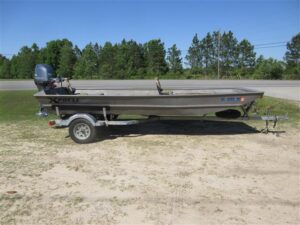 Jon boats are among the most practical and versatile boats on the water. Their flat-bottom or modified-V aluminum hulls make them useful for fishing, hunting, wildlife management, shallow-water travel, property maintenance, and general recreation.
Because jon boats are often simpler than cabin cruisers, wake boats, or offshore fishing boats, they can also be less expensive to own and maintain. Even so, larger models equipped with powerful outboard engines, trolling motors, electronics, storage compartments, hunting blinds, and premium trailers can cost thousands of dollars.
Buyers looking for a lower-cost option may consider jon boat repos offered by banks, credit unions, and other financial institutions.
When a borrower defaults on a boat loan, the lender may repossess the boat and offer it for sale. RepoFinder helps buyers locate repossessed boats sold directly by banks and credit unions throughout the United States.
What Is a Jon Boat Repo?
A jon boat repo is a boat recovered by a lender after the borrower stopped making the required loan payments. The lender may sell the boat directly, request written offers, use sealed bids, consign it to a dealer, or send it to an auction.
The sale may include:
- The aluminum boat
- An outboard motor
- A trailer
- A trolling motor
- Marine batteries
- Fish-finding electronics
- Storage compartments
- Hunting or fishing accessories
Do not assume that every item shown in photographs is included. Some accessories may belong to a former owner, marina, storage company, or recovery contractor.
Most repossessed jon boats are sold as-is without warranties. Buyers should verify the condition of the boat, motor, trailer, and paperwork before making an offer.
Why Buy a Repossessed Jon Boat?
- Potential savings compared with dealership inventory
- Simple construction compared with larger boats
- Relatively affordable maintenance
- Useful for fishing, hunting, and shallow water
- Easy to tow and store in many cases
- Opportunity to buy directly from a bank or credit union
- Some sales may avoid large auction buyer fees
- Certain lenders may accept reasonable offers
- Some lenders may offer financing
A low asking price does not always mean the boat is a bargain. A damaged transom, cracked weld, neglected outboard engine, corroded trailer, or missing title can quickly erase the apparent savings.
Types of Jon Boat Repos
Small Utility Jon Boats
Small utility jon boats are commonly 10 to 14 feet long and may be powered by a small outboard motor, trolling motor, or oars. They are often used on ponds, small lakes, canals, and protected waterways.
Fishing Jon Boats
Fishing models may include raised casting decks, pedestal seats, livewells, rod holders, storage compartments, fish finders, trolling motors, and navigation lights.
Hunting Jon Boats
Hunting jon boats are often configured for duck hunting, marsh access, and shallow-water travel. They may have camouflage finishes, mud motors, surface-drive engines, gun boxes, lighting systems, dog ladders, or removable blinds.
Modified-V Jon Boats
Modified-V hulls have a sharper bow than traditional flat-bottom jon boats. They may provide a smoother ride in moderate chop while retaining much of the shallow-water capability buyers expect from a jon boat.
Commercial and Work Jon Boats
Larger jon boats may be used by property owners, contractors, government agencies, wildlife managers, marina operators, and commercial fishermen. These boats may have reinforced hulls, center consoles, larger engines, work decks, or specialized equipment.
Center Console Jon Boats
Some larger jon boats include a center console with steering, throttle controls, gauges, electronics, switches, and storage. These models may resemble small bay boats while retaining an aluminum utility hull.
Mud Boats
Mud boats are designed for extremely shallow water, marshes, flooded timber, and areas with vegetation. They may use long-tail or surface-drive mud motors rather than conventional outboards.
Jet Jon Boats
Some jon boats use outboard jet drives to travel through shallow rivers. Jet propulsion reduces the amount of equipment hanging below the hull, but the intake and impeller require careful inspection.
Popular Jon Boat Brands
Bank and credit union inventory changes constantly, but repossessed jon boats may include models from manufacturers such as:
- Tracker
- Lowe
- Crestliner
- Alumacraft
- War Eagle
- G3
- SeaArk
- Xpress
- Havoc
- Excel
- Alweld
- Weld-Craft
- Legendcraft
- Polar Kraft
- Ranger
- Grizzly
- Smoker Craft
- Lund
- Roughneck
- Duracraft
- Go-Devil
- Prodigy
The brand alone does not determine value. Buyers should consider the model year, hull size, aluminum thickness, welded or riveted construction, engine type, engine hours, trailer, accessories, condition, and local demand.
Flat-Bottom vs. Modified-V Jon Boats
| Feature | Flat Bottom | Modified-V |
|---|---|---|
| Shallow-Water Access | Excellent | Very good |
| Stability at Rest | Generally excellent | Good |
| Ride in Chop | Can be rough | Usually smoother |
| Common Use | Ponds, marshes, calm lakes | Lakes, rivers, moderate chop |
Welded vs. Riveted Jon Boats
Welded Aluminum Hulls
Welded jon boats use continuous or segmented welds to join hull components. They are common on heavier-duty fishing, hunting, and commercial boats.
Potential advantages include:
- Strong construction
- Fewer rivet-related leaks
- Availability in thicker aluminum
- Suitability for larger motors
- Heavy-duty configurations
Inspect welded hulls for cracked welds, poor repairs, distortion, stress cracks, and corrosion around welded areas.
Riveted Aluminum Hulls
Riveted jon boats may be lighter and less expensive. They can provide many years of service, but impacts and age may loosen rivets or create small leaks.
Inspect for:
- Loose rivets
- Missing rivets
- Leaking seams
- Sealant repairs
- Cracks around rivet holes
- Distorted hull panels
How Much Do Repo Jon Boats Cost?
| Jon Boat Type | General Used or Repo Price Range |
|---|---|
| Small Hull Only | $500-$4,000+ |
| Small Boat, Motor, and Trailer Package | $2,500-$12,000+ |
| Fishing Jon Boat | $7,500-$25,000+ |
| Hunting or Mud Boat | $10,000-$35,000+ |
| Large Center Console Jon Boat | $20,000-$60,000+ |
These are broad examples rather than guaranteed repo prices. Actual value depends on the boat, engine, trailer, equipment, age, condition, and local market.
What Determines a Jon Boat’s Value?
- Boat length and width
- Hull thickness
- Welded or riveted construction
- Flat-bottom or modified-V design
- Outboard engine size
- Engine hours
- Mud motor or jet-drive equipment
- Trailer condition
- Trolling motor
- Battery system
- Fish finder and electronics
- Livewell and storage configuration
- Hunting or fishing accessories
- Maintenance history
- Freshwater or saltwater use
What to Inspect Before Buying a Repo Jon Boat
Jon boats are relatively simple, but they can still have structural, mechanical, electrical, and documentation problems. Most repossessed boats are sold as-is, making a thorough inspection important.
Hull Exterior
- Inspect the bottom, sides, bow, and transom
- Look for dents, punctures, gouges, and deep scratches
- Check for visible patches
- Look for distorted hull panels
- Inspect chines and seams
- Check drain plugs and fittings
- Look for signs of grounding or impact damage
- Verify the hull identification number
Welds
- Inspect factory welds
- Look for hairline cracks
- Check corners and high-stress areas
- Inspect the transom braces
- Look for amateur repairs
- Check for leaks or discoloration around welds
- Inspect accessory mounting points
Rivets and Seams
- Look for loose or missing rivets
- Check for leaking seams
- Inspect around seats and structural ribs
- Look for excessive sealant
- Check for cracks around rivet holes
- Inspect previous repairs
Transom
The transom supports the outboard motor and receives substantial stress during acceleration, trailering, and operation.
- Inspect for cracks
- Look for bending or flexing
- Check motor mounting holes
- Inspect reinforcement brackets
- Look for corrosion
- Check internal wood when used
- Inspect welds around the transom
- Confirm the motor does not exceed the hull rating
Floor and Decking
Some jon boats have exposed aluminum floors, while others use plywood, composite material, carpet, vinyl, or removable panels.
- Walk across the entire floor
- Look for soft or weak areas
- Inspect plywood for rot
- Check carpet or vinyl for water damage
- Inspect mounting screws and fasteners
- Look beneath removable panels
- Check for trapped water
- Inspect raised casting decks
Structural Ribs and Bracing
- Inspect interior ribs
- Look for cracks or separation
- Check for bent supports
- Inspect seat bases
- Look for loose fasteners
- Check transom braces
- Inspect console mounts
Water Test
When permitted, place the boat in the water and inspect for leaks. Small aluminum leaks may not be obvious when the boat is sitting on a trailer.
During the test:
- Inspect all seams and rivets
- Look beneath flooring
- Check the drain-plug area
- Inspect livewell plumbing
- Check through-hull fittings
- Watch for water near the transom
Inspect the Outboard Motor
The engine may be worth as much as or more than the aluminum hull. A neglected outboard can turn an inexpensive repo into an expensive repair project.
Cold Start
Ask to see the motor started cold. A warm engine may conceal hard starting, weak compression, fuel-system problems, or excessive smoke.
Compression
Compression readings should be reasonably consistent across the cylinders. A marine mechanic can perform a compression or leak-down test.
Computer Diagnostics
Modern outboards may store engine hours, fault codes, temperature events, overspeed events, and operating history. Ask whether a diagnostic report is available.
Cooling System
- Verify water-pump flow
- Inspect the telltale stream
- Check for overheating alarms
- Inspect thermostats when appropriate
- Ask when the water-pump impeller was replaced
Lower Unit
- Inspect the gear-case housing
- Look for impact damage
- Check lubricant condition
- Look for water contamination
- Inspect seals
- Test forward and reverse
- Check for abnormal noise
Propeller
- Inspect blades for bends and chips
- Check the propeller shaft
- Look for fishing line around the shaft
- Inspect the hub
- Check for excessive vibration
Trim and Tilt
- Test full movement
- Listen for abnormal noise
- Inspect hydraulic cylinders
- Look for leaks
- Check trim switches
Steering
- Turn the motor through its full range
- Check cables or hydraulic lines
- Look for binding
- Inspect the steering wheel and helm
- Check for excessive play
Inspect Mud Motors and Surface Drives
Hunting jon boats may use long-tail or surface-drive mud motors. These engines operate in abrasive environments and may encounter mud, vegetation, stumps, rocks, and shallow bottoms.
Inspect:
- Propeller wear
- Drive shaft
- Bearings
- Seals
- Engine mounts
- Frame welds
- Throttle controls
- Exhaust system
- Oil condition
- Hours and maintenance records
Inspect Outboard Jet Drives
Outboard jet systems use an intake and impeller rather than a conventional propeller. They are useful in shallow rivers but can suffer damage from rocks, gravel, sand, and debris.
- Inspect the intake grate
- Check the impeller
- Measure excessive clearance when appropriate
- Look for impact damage
- Inspect the housing
- Test steering and reverse gates
- Check for vibration
- Review service records
Trolling Motor Inspection
- Test every speed setting
- Inspect the propeller
- Check the shaft for bending
- Inspect the mount
- Test deployment and stowage
- Check foot pedals or remote controls
- Inspect wiring and plugs
- Test spot-lock or GPS features when equipped
- Confirm the charger is included
Electrical System and Batteries
Modified jon boats may contain extensive wiring for navigation lights, fish finders, livewells, trolling motors, bilge pumps, accessory lighting, and USB outlets.
- Inspect battery age and condition
- Check terminals for corrosion
- Test the battery charger
- Inspect fuse or breaker panels
- Look for loose or exposed wiring
- Check wire connections below the deck
- Test navigation lights
- Test bilge pumps
- Test livewell pumps
- Look for amateur modifications
Fish Finders and Electronics
- Power on every display
- Check sonar operation
- Test GPS functions
- Inspect transducers
- Check mounting brackets
- Inspect power cables
- Confirm mapping cards are included
- Check software compatibility
- Test networking between displays
Livewell and Plumbing Systems
- Fill and drain the livewell
- Test aerator pumps
- Inspect hoses and clamps
- Look for leaks
- Check drain fittings
- Inspect switches and wiring
- Test recirculation systems
- Look for freeze damage
Inspect Hunting Accessories
A hunting jon boat may include equipment that adds value but also requires inspection.
- Removable blinds
- Camouflage panels
- Gun boxes
- Dog ladders
- Interior lighting
- Light bars
- Decoy storage
- Bilge pumps
- Push poles
- Seat mounts
Confirm which accessories are included in the sale and whether they are permanently attached to the boat.
Inspect the Jon Boat Trailer
The trailer is an important part of the package. Even a small boat may be difficult to move if the trailer is unsafe or lacks valid paperwork.
- Verify the trailer identification number
- Confirm title or registration documents
- Check the weight rating
- Inspect the frame and crossmembers
- Look for rust and corrosion
- Inspect welds
- Check bunks and rollers
- Inspect the winch and strap
- Check the bow stop
- Inspect the coupler
- Check the jack
- Inspect safety chains
- Test trailer lights
- Check wiring
- Inspect tires and date codes
- Check wheel bearings
- Inspect axles and suspension
- Test brakes when equipped
Saltwater Corrosion
Aluminum jon boats can be used in saltwater, but corrosion protection and maintenance are important. Saltwater exposure can affect the hull, engine, wiring, trailer, and hardware.
Inspect for:
- Pitting in aluminum
- White powdery corrosion
- Corroded electrical terminals
- Rust on trailer components
- Damaged sacrificial anodes
- Corrosion around stainless fasteners
- Salt deposits in the engine
- Corroded steering components
- Damaged paint or protective coatings
Common Jon Boat Repairs
| Common Repair | Why It Matters |
|---|---|
| Cracked Weld Repair | Structural cracks can allow leaks and spread under repeated stress. |
| Rivet and Seam Repair | Loose rivets and damaged seams can cause persistent leaks. |
| Transom Repair | The transom must safely support the outboard motor. |
| Outboard Engine Repair | The engine may represent a large portion of the package value. |
| Floor Replacement | Plywood and carpet may rot after long-term water exposure. |
| Electrical Rewiring | Improper wiring can cause equipment failures or safety problems. |
| Trailer Repair | Tires, bearings, lights, bunks, and axles may require immediate work. |
Does a Repo Jon Boat Have a Title?
Boat ownership requirements vary by state. The lender may provide a vessel title, transferable registration, lien release, bill of sale, or another ownership document.
The outboard motor may require separate documentation in some states. The trailer may also have its own title or registration.
Before making an offer, ask:
- What boat ownership document will be provided?
- Will the lender release every lien?
- Does the hull identification number match the paperwork?
- Does the engine serial number match the listing?
- Is separate outboard documentation required?
- Does the trailer have valid paperwork?
- Can the boat be registered in your state?
- Will the lender provide a bill of sale?
Confirm What Is Included in the Sale
Accessories can represent a meaningful portion of a jon boat package’s value. Obtain written confirmation of everything included.
- Aluminum boat
- Outboard motor
- Propeller
- Fuel tank
- Trailer
- Trolling motor
- Marine batteries
- Battery charger
- Fish finder
- GPS equipment
- Livewell equipment
- Seats and pedestals
- Hunting blind
- Light bars
- Rod holders
- Anchors
- Safety equipment
- Keys and manuals
How to Research a Repo Jon Boat’s Value
Compare the repossessed boat with similar packages offered by dealers and private sellers. Use the same manufacturer, model, year, length, width, hull type, engine, trailer, and equipment whenever possible.
Evaluate:
- Hull condition
- Weld or rivet condition
- Transom strength
- Engine model and hours
- Engine diagnostics
- Trolling motor
- Electronics
- Battery age
- Floor and deck condition
- Trailer condition
- Included accessories
- Ownership documents
- Immediate repair needs
Calculate the Total Purchase Cost
Potential expenses include:
- Marine inspection
- Engine diagnostics
- Compression testing
- Hull welding
- Rivet or seam repair
- Transom repair
- Floor replacement
- Outboard service
- Propeller replacement
- Battery replacement
- Electrical repair
- Trolling-motor repair
- Trailer tires and bearings
- Transportation
- Taxes and registration
- Insurance
- Required safety equipment
Bank Repo vs. Dealer vs. Auction Jon Boats
| Buying Source | Potential Advantages | Potential Disadvantages |
|---|---|---|
| Boat Dealer | Possible reconditioning, financing, and trade-ins | Higher retail pricing |
| Boat Auction | Competitive bidding and varied inventory | Buyer fees and limited inspection opportunities |
| Bank or Credit Union Repo | Direct access and potentially competitive pricing | Usually sold as-is |
| Private Seller | Potential negotiation and ownership-history information | Condition and paperwork vary |
Can You Finance a Repo Jon Boat?
Financing depends on the selling institution, purchase price, boat age, engine, condition, and documentation. Some banks and credit unions may finance repossessed boats they own, while others require outside financing or full payment.
Ask about:
- Available loan terms
- Interest rates
- Required down payment
- Minimum loan amount
- Boat-age restrictions
- Credit requirements
- Insurance requirements
- Payment deadlines
- Accepted forms of payment
How to Make an Offer on a Repo Jon Boat
- Review the listing and all available photographs.
- Contact the bank or credit union to confirm availability.
- Ask exactly what equipment is included.
- Confirm the boat, engine, and trailer paperwork.
- Inspect the hull, welds, rivets, transom, and flooring.
- Request a cold engine start.
- Obtain compression and diagnostic information.
- Test the trolling motor and electronics.
- Inspect the trailer.
- Conduct a water test when permitted.
- Research comparable jon boat packages.
- Estimate all repairs and transportation expenses.
- Submit an offer according to the lender’s instructions.
- Confirm payment and removal deadlines.
Questions to Ask the Selling Lender
- Is the jon boat still available?
- Can it be inspected?
- Can it be placed in the water?
- Does the outboard start and run?
- Are engine hours available?
- Is a diagnostic report available?
- Are there known hull leaks?
- Are there cracked welds or damaged rivets?
- Has the transom been repaired?
- Does the trolling motor work?
- Do the electronics operate?
- Are the batteries included?
- Is the trailer included?
- Does the trailer have paperwork?
- What accessories are included?
- What boat ownership documents are provided?
- Will all liens be released?
- Is the price fixed or negotiable?
- Are sealed bids required?
- What payment methods are accepted?
- How quickly must the boat be removed?
Where to Find Bank Repo Jon Boats
Banks and credit unions advertise repossessed jon boats through their own websites, dealers, storage facilities, recovery companies, and auction services. Some lenders maintain dedicated repossession pages, while others list boats with vehicles, RVs, motorcycles, and equipment.
RepoFinder organizes links to lender-owned inventory so buyers can locate boats offered directly by financial institutions.
Start by browsing current boat repos offered by banks and credit unions.
Related RepoFinder guides include:
- Fishing Boat Repos for Sale
- Bass Boat Repos for Sale
- Center Console Boat Repos for Sale
- Wake Boat Repos for Sale
- Houseboat Repos for Sale
- Repo Boats for Sale
- Repo Boats for Sale by Banks
- 5 Tips for Buying a Repossessed Boat
- Where to Find Bank Repo Boats
Frequently Asked Questions
Are jon boat repos cheaper than dealer boats?
They can be, but buyers should compare the asking price with the condition of the hull, engine, trailer, batteries, electronics, and required repairs.
What types of repossessed jon boats are available?
Inventory may include small utility boats, fishing boats, hunting boats, modified-V boats, center-console models, mud boats, and jet-powered jon boats.
Can anyone buy a repossessed jon boat?
Most bank-owned boats are available to individuals and businesses. Each lender establishes its own inspection, bidding, payment, and removal procedures.
Do repo jon boats come with warranties?
Most are sold as-is without warranties. Buyers should inspect the hull, transom, motor, trailer, electrical system, and documentation.
Should I have the outboard inspected?
Yes. A qualified marine mechanic can perform compression testing, inspect the lower unit, retrieve diagnostic information, and identify potential repair needs.
Should I water-test a jon boat before buying?
A water test can reveal leaks, engine problems, steering issues, vibration, and handling concerns that may not be visible while the boat is on a trailer.
Does the trailer come with the boat?
Only when the lender specifically includes it. Confirm the trailer and its paperwork before submitting an offer.
Are the trolling motor and electronics included?
Not necessarily. Ask the lender for a written inventory of every item included in the sale.
Can I finance a repossessed jon boat?
Some lenders may finance boats they own, while others require outside financing or full payment.
Can I negotiate the asking price?
Some banks and credit unions accept offers, while others use fixed prices, sealed bids, or auctions.
Does RepoFinder sell jon boats?
No. RepoFinder helps buyers locate jon boats offered by banks, credit unions, and other financial institutions. Buyers complete the purchase directly with the selling lender.
Final Thoughts
Jon boat repos can provide opportunities for buyers seeking practical fishing boats, hunting boats, shallow-water boats, and aluminum utility vessels. Their relatively simple construction can make them easier to inspect and maintain than larger recreational boats, but condition still matters.
Inspect the hull, welds, rivets, transom, flooring, engine, trolling motor, electronics, batteries, trailer, and ownership documents. Research comparable packages and calculate every immediate expense before submitting an offer.
Browse jon boats and other repossessed boats offered directly by banks and credit unions.